The tax reform will replace all consumption taxes with a VAT (value-added tax), paid by the final consumer, charged non-cumulatively at all stages of the production chain.
The five current consumption taxes (IPI, PIS, Cofins, ICMS and ISS) are replaced by two consumption taxes (IBS and CBS) and a Selective Tax (IS).
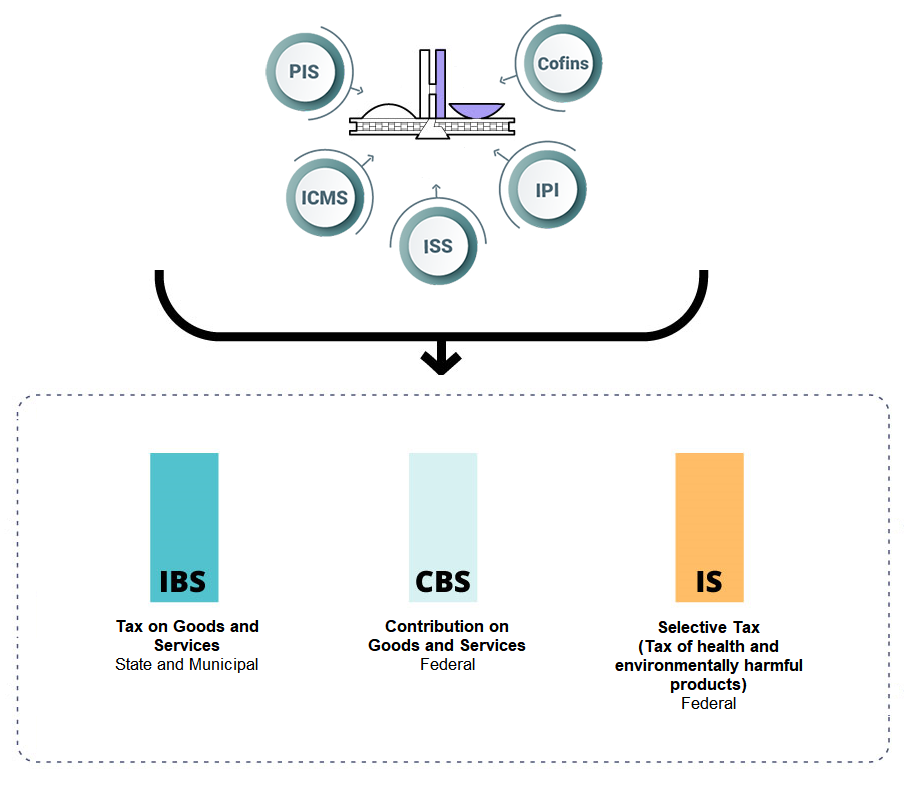
IBS (Tax on Goods and Services) / CBS (Contribution on Goods and Services)
In both proposals, IBS and CBS have the following characteristics:
- They are charged on all operations with tangible or intangible goods and services
- They are charged at all stages of the production chain, giving the right to credit for the previously paid tax (non-cumulative)
- They are not charged on exports
- They are charged on imports
- They adopt the principle of destination (rate and collection linked to the place of consumption)
- Provide for a single rate for all goods and services consumed in each location
- Due to the particularities of certain sectors, differentiated taxation regimes are foreseen for:
- Financial services, real estate, fuel, public sector procurement, health care plans, and prediction contests
- Real estate, fuel, public sector acquisitions, tobacco products and financial intermediation
- There are plans for special treatments to reduce the impact of changing the model:
- 50% reduction of IBS and CBS rates for:
- urban, semi-urban or metropolitan public transport services;
- medicines;
- medical devices and healthcare services;
- education services;
- agricultural, fishing, forestry and plant extractive products in natura;
- agricultural inputs, food intended for human consumption and personal hygiene products
- national artistic and cultural activities
- exempt public urban, semi-urban or metropolitan transport services;
- reduce by 100% the rate of CBS and IBS levied on medications;
- reduce by 100% the CBS rate levied on higher education services (PROUNI) and, until 12/28/2027, on services benefited by the Emergency Program for the Resumption of the Events Sector (Perse)
- 50% reduction of IBS and CBS rates for:
- Complementary law will define the sectors that will have differentiated treatment;
- Provide for the maintenance of the global tax burden on consumption
- Makes taxation on consumption less unfair, as they adopt the possibility of refunding the tax (cashback). In this way, the granting of tax benefits is focused on those who need it most, in contrast to the option for exemptions by type of merchandise.
- Preserve Simples Nacional and the favored treatment of the Manaus Free Zone
- Maintain constitutional bonds and divisions, such as Health and Education
- Contain transitional rules, shorter for society in general (taxation regime) and longer and smoother for sharing with states and municipalities (sharing system)
IS (Selective Tax)
The Selective Tax will be charged to discourage the consumption of goods and services harmful to Health and the Environment, such as alcoholic beverages, cigarettes and pollutants.